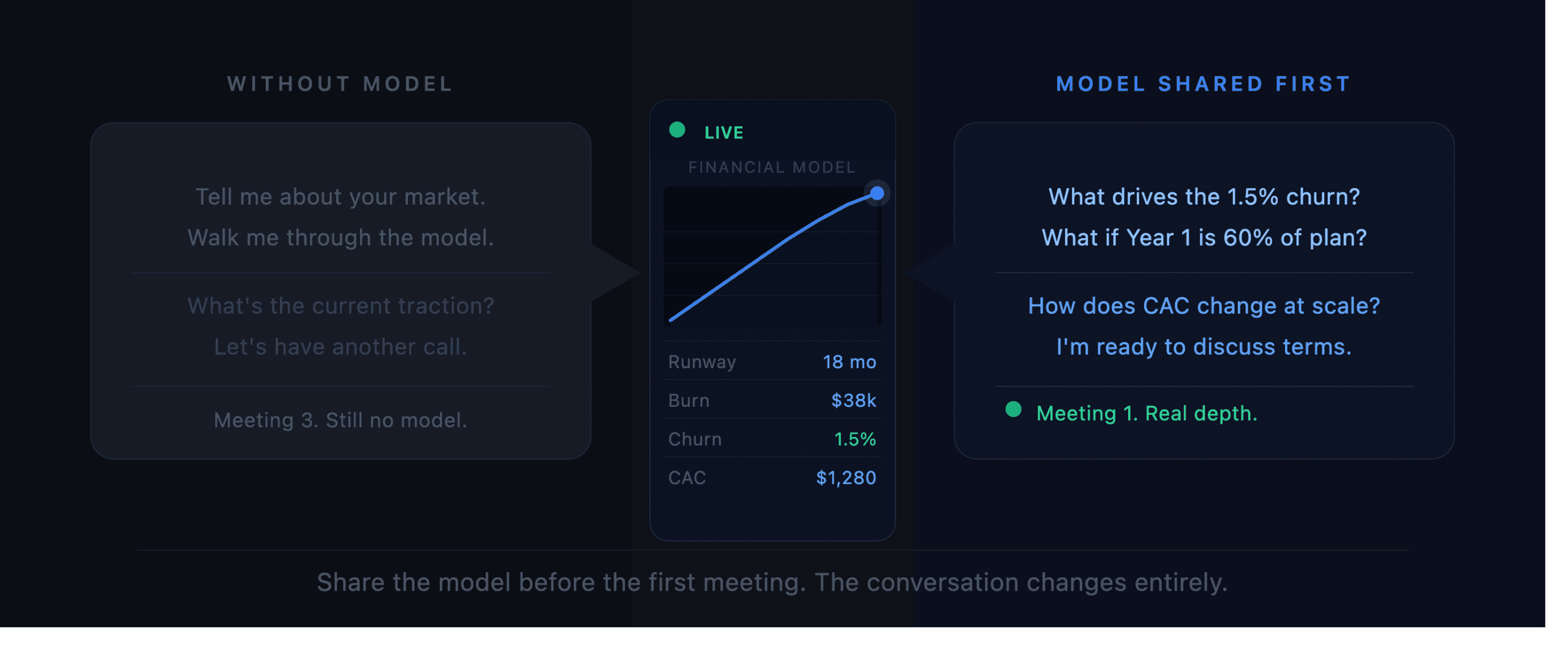
TL;DR: share your financial model earlier than you think — ideally before your first meeting, not after your third — and share it through a governed, interactive workspace rather than a raw spreadsheet. That single decision changes the quality of the conversations you have with investors.
Why Share a Financial Model at All?
A pro-forma financial model is the fastest way for an investor to assess the seriousness of your pitch as an actual business; founders who provide one demonstrate that they understand the economics of the proposed enterprise and have thought through their pathway(s) to success.
An investor who has explored your model before your first meeting doesn’t arrive with generic questions — they arrive with informed ones. They’ve already tested a growth assumption or examined what happens to your runway under different scenarios. Instead of seeing your revenue projections for the first time on slide 12 and politely nodding, they’re ready to discuss the underlying economics of your business.
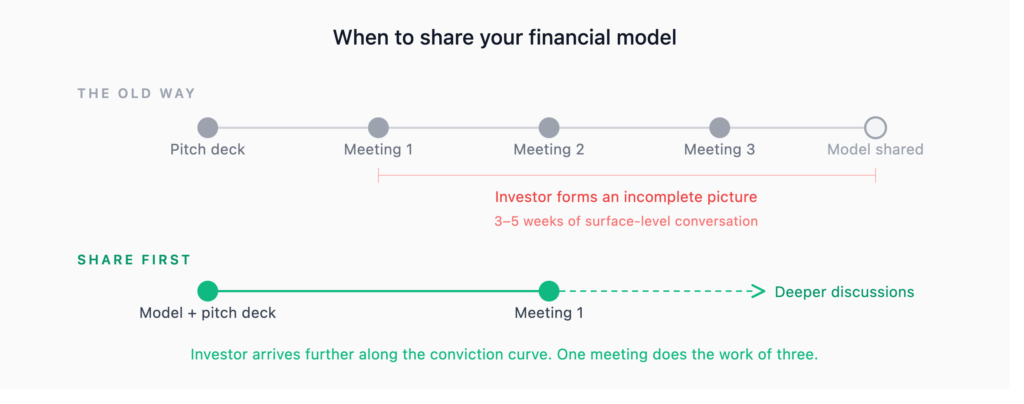
The period between an investor’s first look and your first meeting is one of the most underutilized parts of the fundraising process. Most founders share a pitch deck — perhaps an executive summary — and hold back the financial model until an investor requests it, usually after two or three conversations. By then, the investor has already formed an incomplete picture of the business, and changing that impression is harder than most founders expect.
What Investors Actually Do With a Model
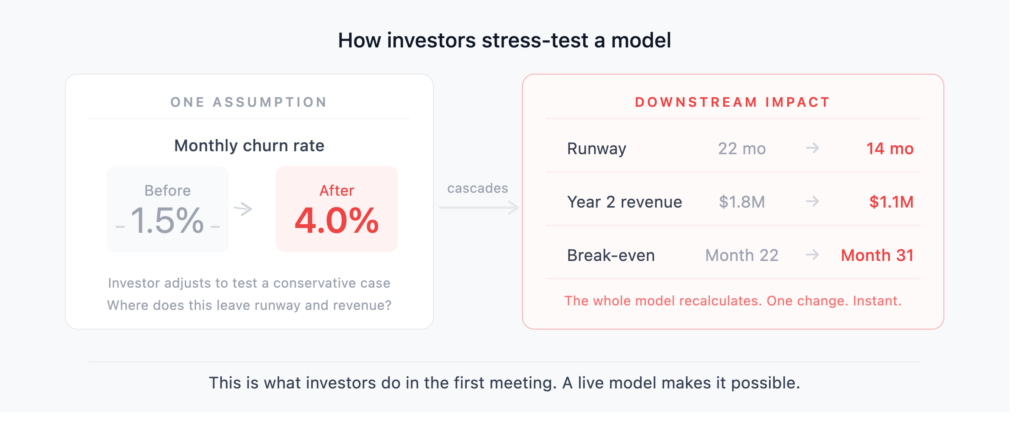
Investors don’t read financial models like reports. They use them to test the logic of the business — challenging assumptions and watching how the business performs under different conditions.
They want to know what happens if Year 1 revenue reaches only 60% of plan. They’ll change a customer acquisition assumption to see how sensitive your unit economics are to conversion rates. They’ll run scenarios you never modeled — not to find flaws, but to understand how you’ve thought about the business and whether the numbers reflect reality.
Investors who have already stress-tested the model this way arrive much further along the conviction curve. Instead of spending the meeting on introductions, you can go straight to the business at a much deeper level. That’s when real momentum develops.
This matters most at the pre-seed and seed stages, where there’s little operating history to anchor the discussion — the financial model carries much of the storytelling burden. If you’re still developing yours, our guide to building a seed-stage financial model explains what investors are actually looking for.
Two Good Outcomes, One Bad One
When founders share their model early and in a format investors can genuinely explore, engagement tends to split cleanly: some investors get convinced by the underlying logic before the meeting even happens, and discussions move fast. Others conclude the opportunity isn’t a fit and disengage early — which is also useful. A quick “no” from an investor who fully explored the model beats three unproductive meetings that were never going to lead anywhere. Either outcome accelerates qualification.
The one outcome you want to avoid is investor confusion. That risk is real — but it comes from how the model is shared, not when. Which is where most founders’ hesitation actually begins.
Why Founders Hesitate
If your first reaction is “I’m not going to hand investors my spreadsheet,” that’s a sensible instinct.
Sharing a raw Excel file creates real problems, and founders who’ve raised capital know them well.
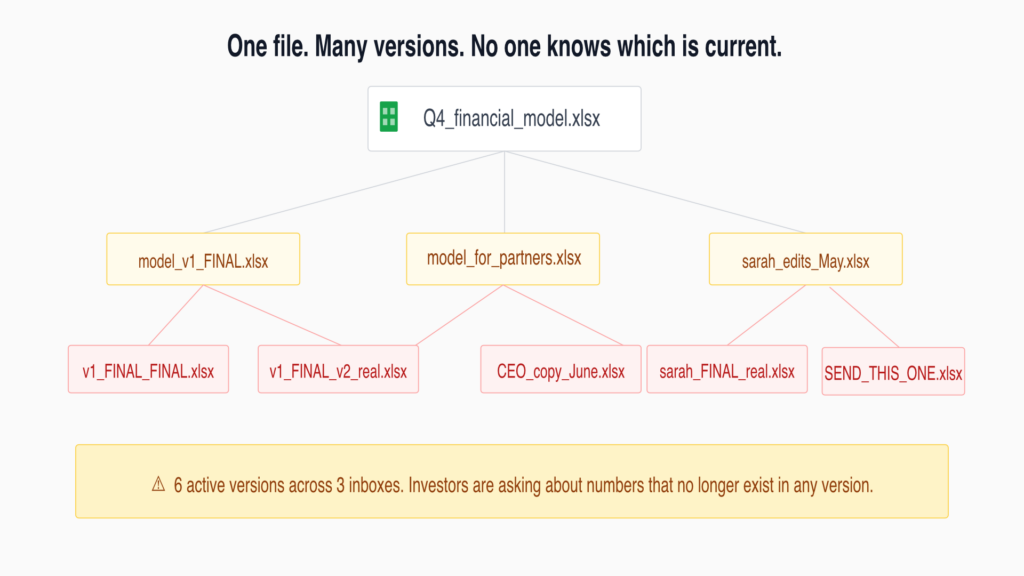
Version control is the obvious one. You send the file to one investor. They forward it to a partner. Someone downloads a local copy and edits it. Within a week, multiple versions are circulating, each with different assumptions — and you’re answering questions about numbers you changed several revisions ago.
The deeper problem is that a spreadsheet can’t preserve the reasoning behind your assumptions. An investor can raise your churn assumption from 1.5% to 4%, and Excel will dutifully recalculate — but it can’t tell them why the original assumption was 1.5%. Maybe it came from pilot data. Maybe it reflected a specific retention mechanism built into the product. None of that context travels with the spreadsheet. The ten-minute explanation you gave during your pitch disappears, leaving only the numbers — and you end up answering questions about a business you never intended to present.
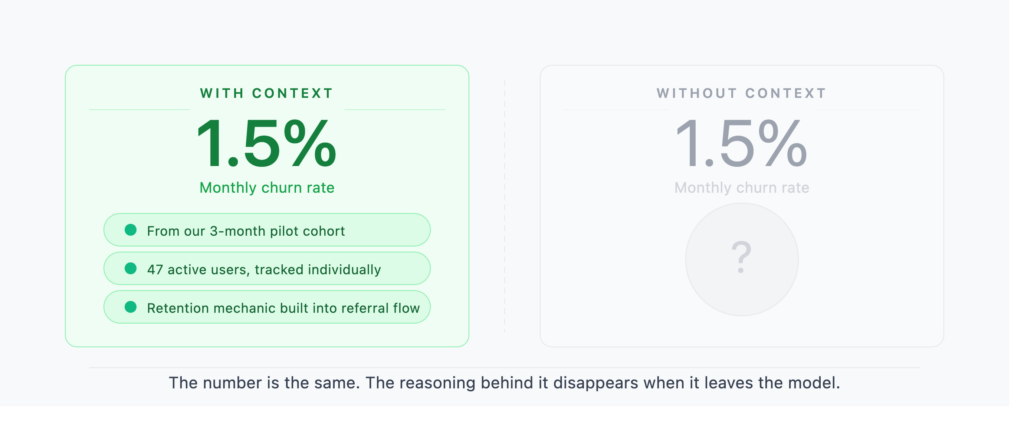
That’s the real fear: not that investors will explore the model, but that the model will become disconnected from the business you’re actually building.
How modelr.ai Solves This
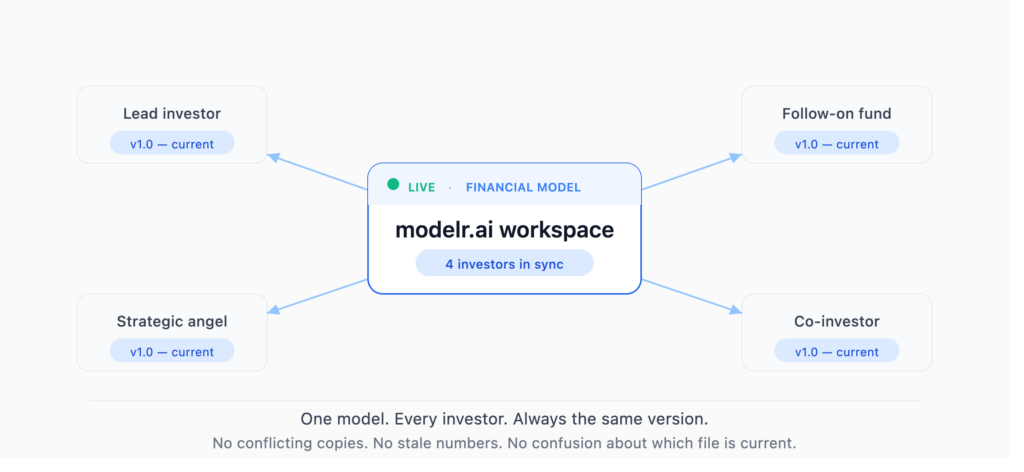
modelr.ai is a governed financial model-sharing platform built for exactly this problem.
Instead of emailing spreadsheets, founders upload their financial model to the platform and invite investors into a live, interactive session — often before the first meeting. Investors can test assumptions, run scenarios, and see how changes affect runway, margins, and growth, without waiting until the third conversation to see real numbers.
The key difference: your reasoning stays attached to the model. When an investor changes churn from 1.5% to 4%, modelr.ai doesn’t just recalculate silently — it surfaces the rationale behind the original assumption, what evidence supports it, and why it was chosen. When a combination of assumptions stops making economic sense, the platform flags why and helps the investor find the question they were actually trying to answer.
And because no spreadsheet ever changes hands, every investor works from the same live model — no conflicting versions, no outdated files, no discussions anchored to numbers you abandoned two revisions ago.
The result: investors arrive at your meeting with substantive questions instead of introductory ones, and every conversation builds on the same foundation instead of a different snapshot of your business.
See it in action: book a modelr.ai demo or explore a sample investor session to see how a governed model changes the first conversation.