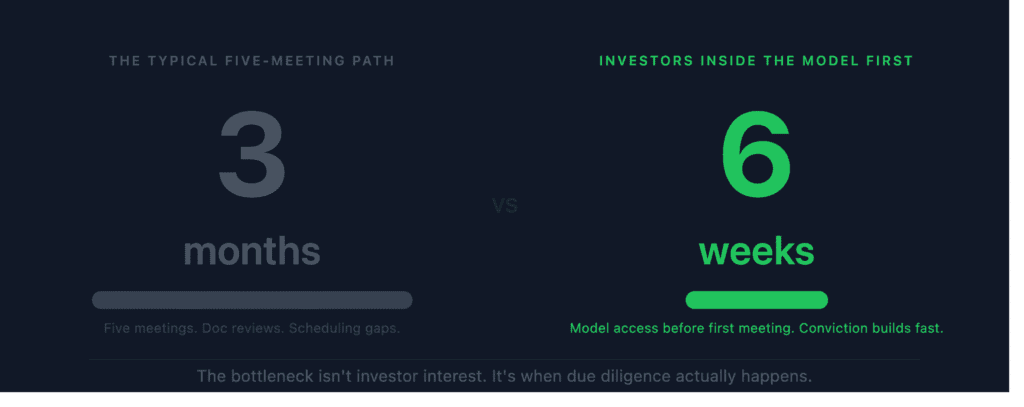
Founders who close seed funding for their startups in six weeks aren’t pitching better than everyone else. They’re getting investors deeper into their plan faster, which compresses the timeline in a way that no amount of follow-up hustle can replicate.
TL;DR: Founders who close seed rounds faster aren’t pitching better – they get investors deep into the real model earlier, often before the first meeting. That compresses due diligence, signals the business can withstand scrutiny, and speeds up passes as well as yeses. The bottleneck usually isn’t investor interest – it’s the format founders use to share their numbers.
What Actually Slows a Seed Round Down
Most seed funding for startups doesn’t stall because investors aren’t interested. It stalls because interest takes a long time to turn into conviction. And conviction, at seed stage, requires investors to feel like they actually understand the business – not just the pitch.
The typical process looks something like this: first meeting goes well, investor says they’re interested, you schedule a second call. Second call goes deeper, investor has follow-up questions, you send some documents. Third call, they want to talk about the market more or meet the co-founder. Somewhere in the fourth or fifth touchpoint, they’ve finally gotten deep enough to form a real view.
Each touchpoint takes a week or two to schedule, plus the time the investor needs to review whatever you sent. A five-meeting path to conviction is a two-to-three-month path. Run that with ten investors and you have a process that can drag almost indefinitely without closing.
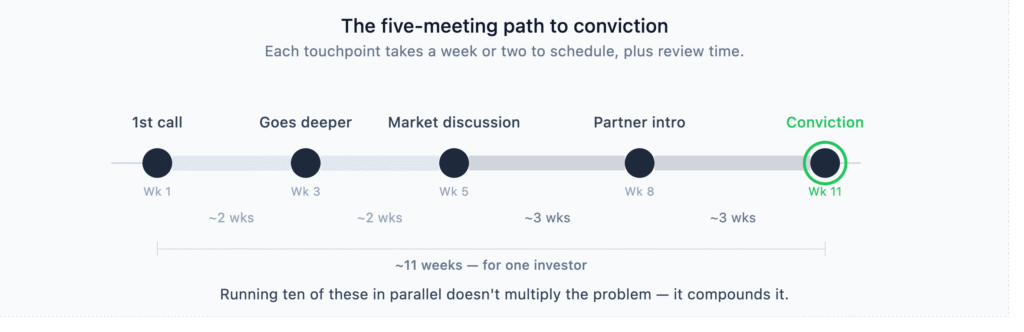
The slowness is structural. Each meeting is doing a small amount of the work that could be front-loaded into the beginning of the process.
Why Getting Investors Deeper Earlier in the Process Changes the Timeline
Founders who close seed funding for their startups faster aren’t having fewer conversations. They’re having better-positioned ones. Specifically, they find ways to get investors past the deck and into thinking through go-to-market (or use-of funds, for later stage deals) scenarios before the second or third meeting where that depth would normally happen.
When an investor has already spent time with the financial model, they arrive at the next meeting differently. They have specific questions, not orientation questions. They’ve already tested an assumption or two. The meeting starts from a more advanced place, which means it ends at a more advanced place. The timeline compresses because each conversation is doing more work.
What front-loaded due diligence looks like from the investor’s side
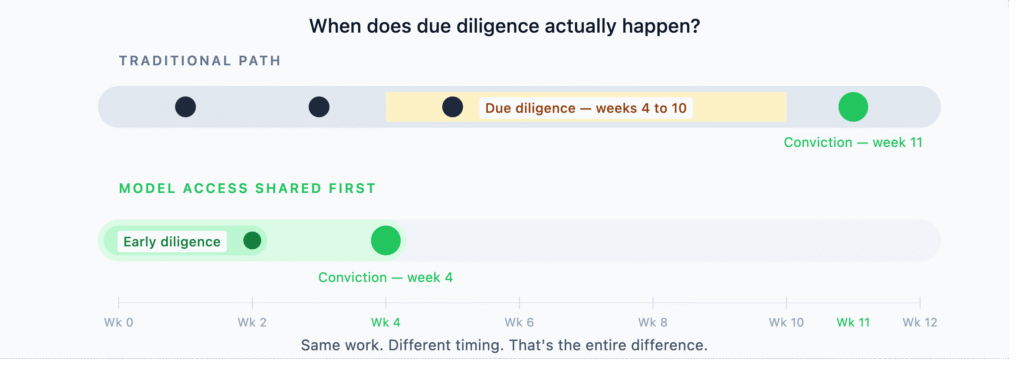
From an investor’s perspective, due diligence is about building enough confidence in the business to justify writing a check. That process has to happen either way. The question is just when.
When it happens late, it looks like a slow parade of follow-up calls and document requests, generally spread across months. When it happens early – when investors can explore the model and stress-test assumptions before the first real meeting – they arrive at a view faster. The same work gets done, just compressed into the front of the process rather than drawn out across multiple touchpoints. Founders who make that possible tend to see shorter paths to term sheets.
Sharing early sends a signal of its own
There’s a second effect at work here, separate from how quickly diligence gets done. A founder willing to put live, interactive numbers in front of an investor this early is implicitly saying something: the business can withstand scrutiny. That reads as investment-readiness on its own.
But it also does something more specific: investors know that a founder who’s offering to share their model is doing the same with other investors. This creates urgency organically – nobody has to say “there’s competition for this round” out loud. That’s not a manufactured pressure tactic. Just a clear signal of a deal that’s in play and a founder who believes that they can demonstrate its fundability.
How fast passes are actually a feature, not a failure
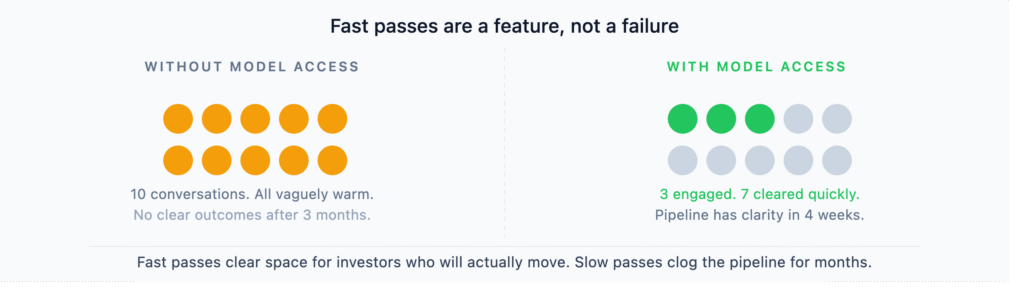
It’s a truism of early-stage fundraising that investors rarely give an outright “no, this one’s not for me”. It’s the bane of founders, but there’s actually a good reason for it: investors know that if they keep the door open, a founder will update them when the deal starts to get traction. It’s like a free option – keep the door open, and save your limited bandwidth until someone else has done the heavy lifting. For founders, it creates a major pipeline problem. A lot of those passes were inevitable. They just came slowly.
Investors who get real access to the business earlier tend to either engage seriously or disengage quickly. Both outcomes are useful. The ones who engage become better leads, faster. The ones who disengage clear space in the pipeline for investors who will actually move. Plus, if you invite them to dig in and they never log in, then that’s a pretty strong sign in and of itself. However it lands, a process that generates fast, clear outcomes on both ends is a much better process than one where everything stays vaguely warm for months.
What Founders Risk When They Try to Move Quickly
Here’s where the obvious advice breaks down. Most of what gets said about founders closing seed funding faster amounts to “share more, earlier.” Send the model. Be transparent. Give investors what they need.
The problem is that sharing more, in the typical sense, means sending a spreadsheet. And a spreadsheet creates its own problems when you’re trying to move fast across multiple parallel conversations.
Version control is the surface issue. You’re running 15 investor conversations at once and every one of them has a slightly different version of your model – some edited, some forwarded to partners, some with assumptions changed to numbers that have nothing to do with the business you’re actually building. You’re now fielding questions from people who are each working from a different picture of your company.
The deeper issue is what happens to the story. Investors who get a raw model will explore it, which is what you want. But a spreadsheet has no way to keep that exploration grounded in your actual business logic. One investor changes your burn rate assumption. Another adjusts your pricing model. A third stress-tests churn at a number that has no relationship to how your product actually retains customers. Each person is developing a view of a company that’s drifted from the one you’re building.
Moving fast with a raw spreadsheet doesn’t compress the timeline. It just creates more surface area for the process to go sideways.
How to Accelerate Without Letting the Story Drift
What actually compresses the timeline is getting investors inside the business earlier, in a way that keeps their exploration connected to reality.
A structured workspace does both things at once. Investors can adjust assumptions, run scenarios, and explore the model the ways they’d naturally want to – but within a defined set of explorable assumptions that stays grounded in the business you’ve presented. When an assumption combination doesn’t reflect the economics of your actual company, the system explains why. No one version-drifts into a different business. Every investor is working from the same underlying model, and the conversation you have with each of them builds on the same foundation.
That’s what modelr.ai is built for. Founders raising pre-seed capital upload their financial model and give investors access to a live, structured session – often before the first meeting. The investors they’re courting engage with the real business, not a version of it that got edited somewhere along the way. Conversations are more substantive from the start. Conviction builds faster.
That’s the process change that actually shortens a round. Not more hustle or better follow-up emails. Getting investors inside the numbers earlier, with a structure that keeps what they’re seeing connected to the company you built.
See it in action: book a modelr.ai demo or explore a sample investor session.