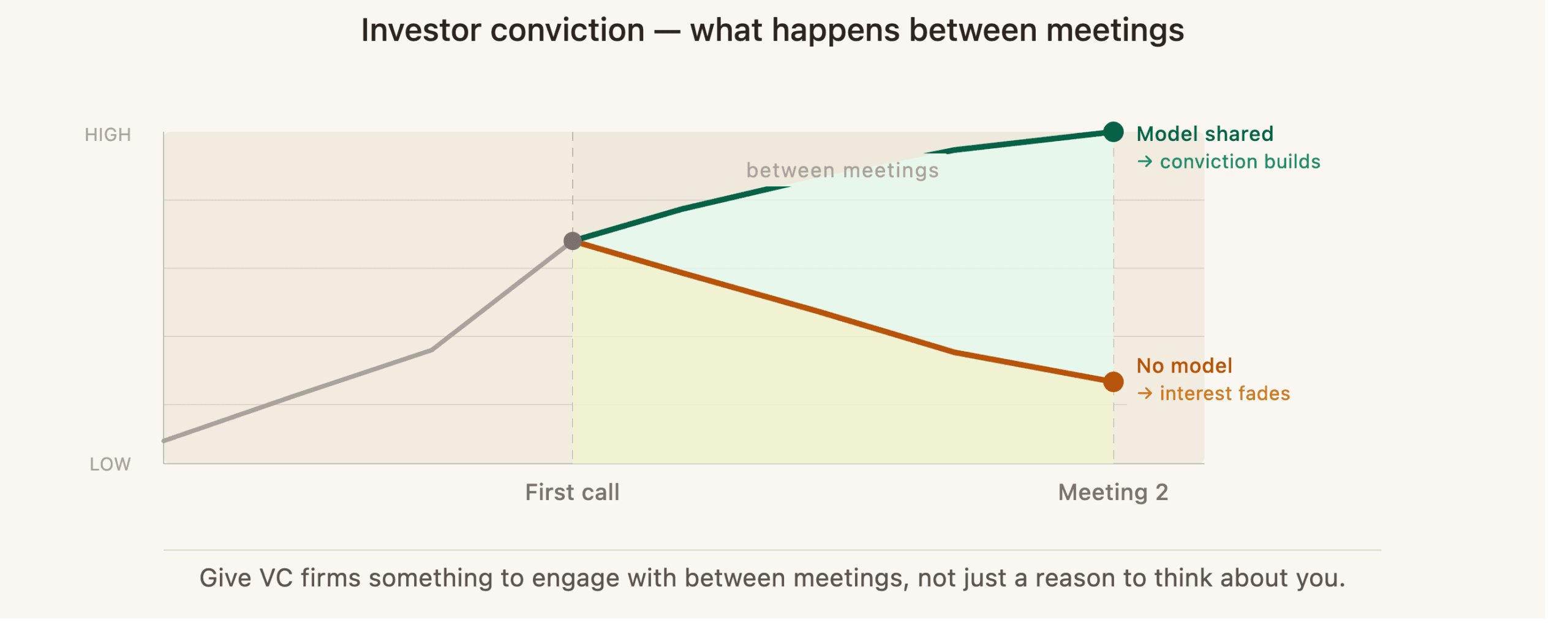
Give VC firms something to engage with between meetings, not just a reason to think about you. That’s what consistently turns first calls into follow-up conversations.
The first meeting with an investor isn’t really the pitch. It’s more like a filter. VC firms are trying to figure out, in 30 or 45 minutes, whether the business is worth spending more time on. The pitch you give might be good – clear thesis, strong team, plausible market – and you still leave without a follow-up because the investor didn’t have enough to anchor their interest to.
The founders who consistently turn first meetings into second ones tend to share one habit. They give VC firms something to engage with after the call. Not a follow-up email with the deck attached again. Something that lets investors actually go deeper on the business, on their own time, before they’ve decided whether to keep going.
That habit is what this is about.
Why Most First Meetings With VC Firms Don’t Lead Anywhere
A typical first investor meeting follows a predictable arc. The founder pitches. The investor asks questions – market size, competition, maybe unit economics. The founder answers. The investor says something like “this is interesting, I’d love to stay close.” And then a few days pass, then a week, and the email you send to check in is responded to with “still thinking” or […crickets…].
What happened is not that the investor changed their mind. It’s that their interest never turned into engagement.
Interest is passive. It just sits there until something more pressing pushes it out. Engagement is different. Engagement means the investor has actually done something with the business – explored it, tested an assumption, dug into a part of it they found interesting. VC firms that have engaged with your business have a reason to come back. They have a specific thing they want to understand better. They’re not evaluating from the outside anymore; they’re already inside the thinking.
Most first meetings generate interest. The ones that lead somewhere generate engagement. That gap is where most fundraising processes stall – it’s one of the main reasons seed funding for startups takes longer than it should – and most founders don’t realize it until they’re six weeks into a raise and wondering why the pipeline isn’t moving.
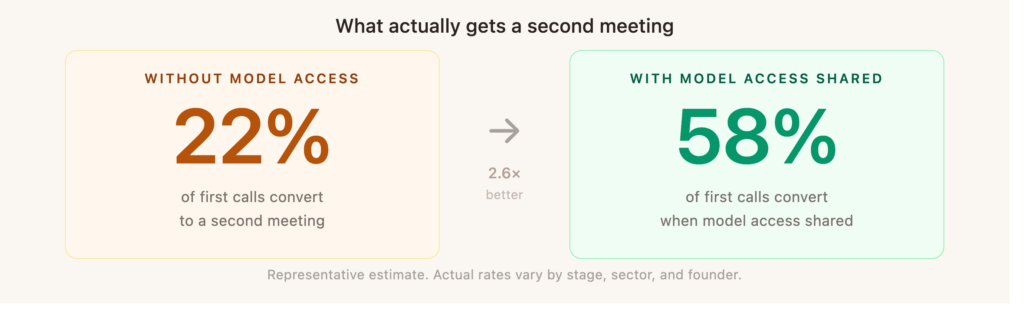
What Venture Capital Firms Actually Need Before They’ll Commit to a Second Call
There’s a thing that happens in first meetings when they go well. The investor gets curious about something specific. A growth assumption, or the path from current ARR to year two, or how the retention numbers hold up at different price points. They want to understand how the business actually works underneath the pitch.
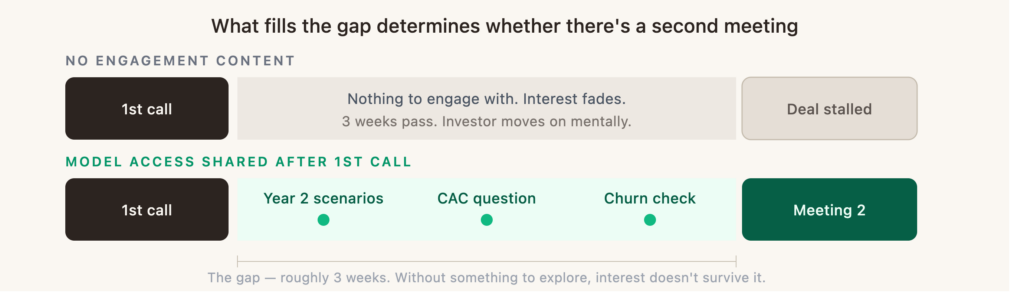
If there’s nowhere to take that curiosity – if all they can do is wait for the next meeting to ask about it – the curiosity fades. The business slides down the mental stack. Something else comes in.
The difference between interest and engagement that justifies next steps
VC firms take second meetings with founders whose businesses they don’t just like, but also feel they understand. That’s a real distinction. A lot of founders get a warm response at the end of a first meeting and interpret it as momentum. But interest is only the starting line.
What moves VC firms to a follow-up is the feeling that they’ve gotten inside the business enough to explore and develop a meaningful view on. The founders who give investors a way to get there – to actually explore the business case, test scenarios, and look at how the assumptions connect to each other – are giving VC firms a reason to stay engaged between meetings. That engagement is what turns “interesting” into “I need a second call.”
What “I’ll circle back” usually means – and what it doesn’t
“I’ll circle back” almost never means “I’m definitely interested but just need more time.” It usually means the investor doesn’t have enough to go on yet. That they liked the pitch but they’re not sure that they understand the business well enough to justify spending more time on it. The interest is real but it’s shallow, and shallow interest doesn’t generate enough mindshare to act on.
Founders who follow up a first meeting with something that invites deeper engagement – something that says “here’s the business, you can actually explore it” – give that interest somewhere to go. Without that, the circle-back doesn’t happen. The deal just quietly falls out of the pipeline.
The Fear That Makes Founders Hold Back Their Best Material
The obvious thing to send after a first meeting is the financial model. It’s the clearest window into how the business actually works – the assumptions, the revenue logic, the path from where you are to where you’re going.
Most founders don’t send it. Or they hold it back until the investor has explicitly asked for it. The reason is usually some version of the same concern: if I share the model with people who I can’t explain it to, who lack context, then I lose control of the narrative. Or, worse, I’ve given them something they can use in doing diligence on another, potentially competing, deal.
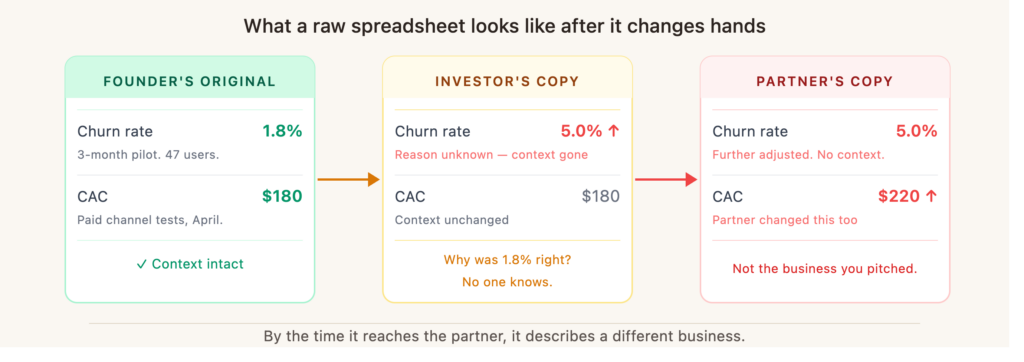
That concern is legitimate. A raw spreadsheet creates real problems. The investor plays with some of the assumptions and then forwards it to a partner. The partner makes their own edits. And so on. Now there are multiple varying versions in circulation, all of which are presumed to be the voice of your company, and you’re getting questions in the follow-up meeting about a business that isn’t the one you pitched.
The deeper problem is that a raw spreadsheet can’t keep the investor’s exploration connected to your actual business. An investor can change your churn assumption from 1.8% to 5% and the model calculates it without any context about why 1.8% was the right number in the first place – grounded in pilot data, or a specific product dynamic, or whatever the real reason is. The assumption you spent ten minutes defending in the meeting just disappeared from the numbers. Now you’re in a conversation about a company you never intended to present.
So founders hold back. Which means VC firms don’t have anything to engage with between meetings. Which means the follow-up doesn’t happen. The fear is understandable, and the outcome is expensive.
How to Give VC Firms Something Real to Engage With Before the Follow-Up
What actually solves this is not a better follow-up email or a more detailed deck. It’s giving VC firms a structured way to go deeper on the model – one that lets them explore without getting the raw file. This is what modelr.ai does.
What that looks like in practice: investors can adjust assumptions, run scenarios, and see how the business responds. Every scenario they test describes a real version of the business. When a scenario falls outside of what the business is designed to do, the system explains why rather than silently calculating a number that looks plausible but isn’t. No raw file changes hands. No version drift. No scenarios that pull the conversation away from the actual business.
modelr.ai is built to let founders seeking VC funding share a structured version of their financial model which investors can explore freely – every scenario stays grounded in the founder’s model and plan.
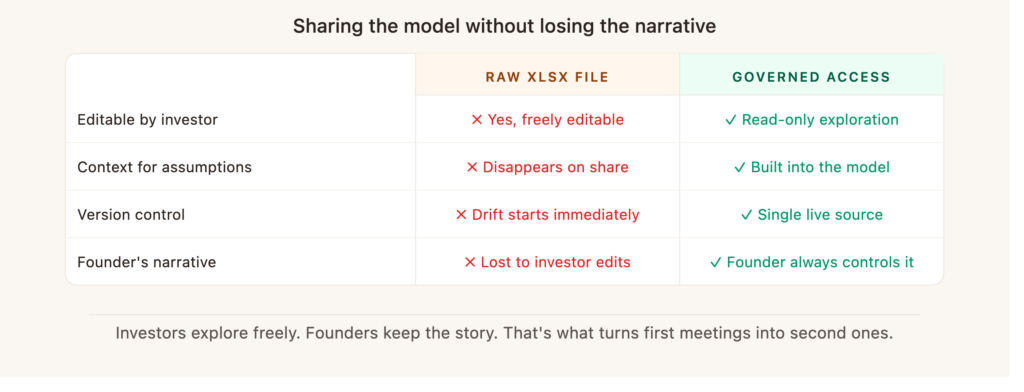
What investors get is the experience of actually engaging with your numbers – the kind of engagement that generates real questions, not generic ones. They arrive at the follow-up meeting having already done something with the business, and that changes the conversation entirely.
What founders keep is control of the story.
That’s what turns a first meeting into a second one. The investor engaged with something real in between. They have a specific question they want answered. They’re not deciding whether to go deeper. They already did.